

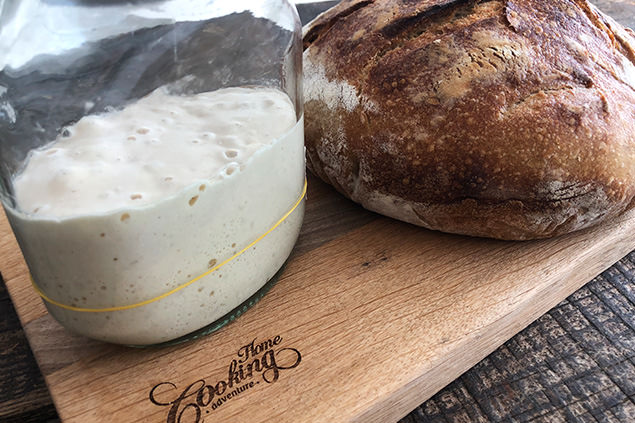
Making a sourdough starter from scratch is much simpler than it may seem. You only need flour, water and a little patience. Over several days, naturally occurring wild yeast and beneficial bacteria begin to ferment the mixture, creating an active starter that can be used to make sourdough bread.
I made my own starter years ago and have kept it going ever since. What started as an experiment quickly became part of my regular bread-baking routine. This is the same basic method I used to get my starter going from scratch.
What Is a Sourdough Starter?
A sourdough starter is a mixture of flour and water that has been allowed to ferment. The natural microorganisms present in the flour and environment feed on the flour and produce carbon dioxide and acids.
The carbon dioxide creates the bubbles and helps sourdough bread rise, while the fermentation gives sourdough its characteristic flavor.
Unlike bread made with commercial yeast, sourdough bread relies on an active starter as its leavening agent.
What You Need to Make a Sourdough Starter
You only need three things:
Flour: This method starts with a combination of rye flour and white bread flour. Rye flour is especially useful during the early days because it contains nutrients that can help encourage fermentation. Once the starter becomes active, you can transition to bread flour.
Water: Use lukewarm or room-temperature water. If your tap water has a strong chlorine smell, bottled or filtered water is a good option.
A clean jar: Choose a jar large enough to allow the starter to rise without overflowing. Keep the lid loosely covered rather than sealing the jar airtight.
Sourdough Starter Feeding Schedule
The first few days are about getting fermentation started. You will discard part of the starter and feed it with fresh flour and water at regular intervals.
Day 1
Mix 100g water with 50g rye flour and 50g white bread flour. Transfer the mixture to a clean jar, cover loosely and leave it at room temperature for 24 hours.
Day 2
You may already see bubbles. Discard all but 75g of starter, then feed it with 75g water, 25g rye flour and 50g white bread flour.
Repeat the same feeding again in the evening, about 12 hours later.
Day 3
Continue feeding every 12 hours using 75g starter, 75g water, 25g rye flour and 50g white bread flour.
Day 4
Your starter may become noticeably bubbly and begin rising after feeding. Continue with the same feeding schedule and ratios.
Day 5
Once the starter is consistently doubling in volume, you can switch to feeding it with white bread flour only. Feed 75g starter with 75g water and 75g bread flour.
This is a 1:1:1 feeding ratio.
Days 6–7
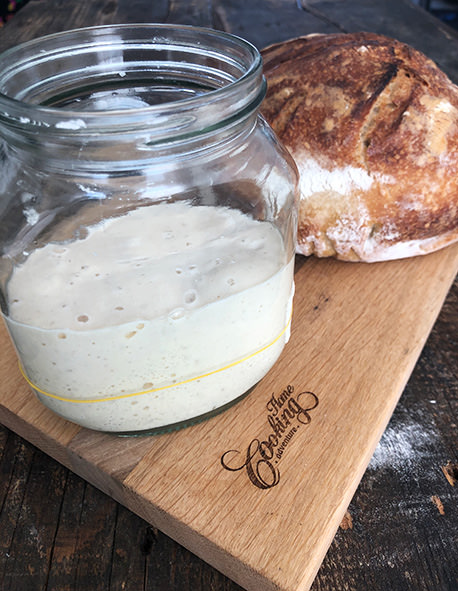
Continue feeding every 12 hours. Your starter should become bubbly, rise predictably after feeding and develop a pleasantly sour smell.
When it consistently doubles in about 8 hours or less, it should be active enough to use for baking.
How Do I Know My Sourdough Starter Is Ready?
A mature starter should show several signs of activity:
- It rises noticeably after feeding.
- It becomes bubbly throughout, not just on the surface.
- It reliably doubles in volume within several hours of feeding.
- It has a pleasant tangy or sour aroma.
- It rises and then gradually falls between feedings.
The most useful test is how predictably it rises after feeding. A starter that doubles consistently is much more useful for baking than one that simply has a few bubbles.
Why Do You Discard Sourdough Starter?
Discarding part of the starter keeps the amount manageable and makes sure the remaining culture receives enough fresh flour and water.
Without discarding, the amount of starter would increase rapidly with every feeding, requiring increasingly large amounts of flour and water.
The discard isn’t necessarily waste. Once your starter is mature, you can save discard and use it in recipes such as pancakes, crackers, waffles or other baked goods.
How to Maintain Sourdough Starter
Once your starter is established, how often you feed it depends on how frequently you bake.
If you bake frequently: Keep the starter at room temperature and feed it regularly, usually every 12 hours.
If you bake occasionally: Store the starter in the refrigerator and feed it about once a week.
Before baking, remove the starter from the refrigerator and give it one or two feedings at room temperature until it becomes active and rises predictably again.
For baking bread, use the starter when it is active and near its peak, rather than after it has completely deflated.
How to Store Sourdough Starter
If you don’t bake every day, the refrigerator is the easiest way to maintain your starter. Keep it in a jar with the lid loosely covered rather than completely airtight.
Once a week, remove it from the refrigerator, let it warm slightly, discard some of the starter and feed it with fresh flour and water. Let it become active at room temperature before returning it to the refrigerator.
If you bake regularly, you can keep your starter at room temperature and continue feeding it every 12 hours.
Sourdough Starter Troubleshooting
My starter rose on Day 2 and then stopped. Is it dead?
Probably not. It is common for a new starter to become very active during the first couple of days and then slow down. Continue the feeding schedule and give it time to develop.
My starter isn’t bubbling. What should I do?
Keep feeding it consistently and make sure it is kept somewhere comfortably warm. Temperature can have a significant effect on fermentation. A cooler room will usually make the process slower.
Can I use only white flour?
Yes, but this particular method starts with rye flour because it can help get the fermentation going. Once the starter is active, this recipe switches to white bread flour.
Why does my starter smell sour?
A sour or tangy smell is normal. Fermentation produces acids, which give sourdough starter its characteristic aroma.
Can I use the starter before Day 7?
You can see activity much earlier, but I recommend waiting until the starter is reliably doubling after feeding before using it to bake bread. A starter that is bubbly but weak may not have enough strength to properly leaven a loaf.
Can I keep my starter in the refrigerator?
Yes. Once the starter is established, refrigeration is a convenient option if you don’t bake frequently. Feed it about once a week and give it one or two room-temperature feedings before using it for bread.
What to Make with Your Sourdough Starter
Once your starter is active, it’s time to bake. Here are a few sourdough recipes to try:
Easy Sourdough Bread – A simple sourdough loaf with a crisp crust and chewy, open crumb. This is the recipe I’d link to most prominently because it is the natural next step after making your starter.
Easy Same-Day Sourdough Bread in a Loaf Pan – A practical sourdough loaf you can mix, proof and bake all in one day. It doesn’t require a Dutch oven, making it a great option for beginners.
Easy Sourdough Bread with Flaxseeds – A hearty sourdough loaf with soaked flaxseeds, bread flour and rye flour. The flaxseeds add a pleasant texture and nutty flavor.
1-2-3 Sourdough Bread – A simple method based on the classic 1-2-3 sourdough formula.
Sourdough Barley Bread – A rustic loaf that adds barley flour for a slightly different flavor and texture.
50 Percent Whole-Wheat Sourdough Bread – A heartier loaf with plenty of whole-wheat flavor while still keeping a light, airy crumb.
Sourdough Starter from Scratch – 7 Day Guide
Ingredients
- White Bread flour
- Rye Flour
- Bottled water , lukewarm
Instructions
- Day 1, in the morning: In a bowl mix 100 g water, 50 g rye flour, and 50 g white flour. Transfer into a clean jar, cover loosely, and leave the culture at room temperature (warm spot) for 24 hours.
- Day 2 in the morning: You should see some bubbles in it. Discard all but 75 g of the culture which you transfer into a clean bowl. Feed this with 75 g water, 25 g rye flour, and 50 g white flour. Wash the jar with simply warm water and transfer the culture into the jar. covered loosely. Let it sit at room temperature (warm spot) for 12 hours.
- Day 2 in the evening: Even if the signs of activity might not be visible, repeat the process as in the morning, discarding all but 75 g of the culture which you transfer into a clean bowl. Feed this again with 75 g water, 25 g rye flour, and 50 g white flour. Transfer to the clean jar, cover loosely, and let it sit at room temperature (warm spot) for 12 hours.
- Day 3 – repeat feeding the culture every 12 hours as in day 2, 75 g culture, 75 g water, 25 g rye flour, and 50g white flour.
- Day 4: On day 4 you may see visible signs of life, the culture is bubbly and raised in volume. Continue feeding every 12 hours, same ratios as in previous days.
- Day 5: Once the starter doubles in volume you can feed the starter using only white bread flour. So it will be 75 g starter, 75 g water, and 75g white bread flour, which is 1:1:1 ratio (equal amounts of starter, water and flour). Repeat feeding the starter every 12 hours.
- Day 6-7: From this moment you have a 100% hydration starter, that is bubbly and has a sour smell, that doubles in 8 hours or less, that should be strong enough to be able to bake your first sourdough bread. You have succeeded!
- Repeat feeding the starter every 12 hours for 14 days to make it stronger. Sourdough starter will rise and deflate between feedings and it gets stronger and active with each feeding process.
How to maintain and store your starter.
- After the first 14 days of regularly feeding you can consider either to store it at room temperature or refrigerating it. If storing at room temperature, daily feedings will be necessary.You should consider keeping it at room temperature if you intend to bake bread almost daily. If not, refrigerating it might be the best storing option. If refrigerating, the sourdough starter needs a weekly feeding process even if you intend to bake bread or not.
- After the first 14 days the starter is active enough and doubles or triples pretty fast. It’s time to change the ratio so you can keep the feeding process to every 12 hours. So you can consider feeding the starter to a ratio of 1:3:3. I use around 20g of starter, discard the rest and mix with 60g water and 60g bread flour.
- If refrigerated, let it to get to room temperature for 1 hour before feeding it. Feed twice, once in the evening and again in the morning after 12 hours, ratio 1:3:3, let it rise and then you can refrigerate again. Repeat these steps each week.
- The best time to remove the starter for creating the levain for bread is after the second feeding, when it is at its peaks, not deflated. Remove in a bowl the amount of starter needed in the recipe, and refrigerate the rest.
Did you make this recipe?
Please let me know how it turned out for you! Leave a comment below and tag @homecookingadventure on Instagram and hashtag it #homecookingadventure.


Hi Ella,
Many thanks for all your efforts to share such great recipes that are beautiful and delighted other than deliciousness that has come along with an artistic flair and professional presentation.
I have made this sourdough starter based on your structure, but it raised before the first 24 hours. It’s tripled now and also bubbling. Is it normal? As this is my 5th try (My first try with your receipt) I don’t want to fail anymore.
Should I feed it before 24 hours?
It’s really amazing recipe but please I need a video for it because I didn’t understand the process of preparing the sourdough starter
Hi! Between the first and second feeding for refrigerated starter, do you put it back in the fridge? Thank you! 🙂
Hello from Ukraine!
Everything you do is perfect. I`ve tried a lot from your recipes and everything went great.
When you feed your starter do you leave it in a dark place or it doesn`t matter?
Curious why rye? Could you sub another flour?
Türkiye’den merhaba, 7 günün sonunda mayayı buzdolabına kaldırıp, haftada sadece bir gün mü besliyorsunuz? Buzdolabında saklanan mayayı birinci ve ikinci besleme arasında tekrar buzdolabına koyuyor musunuz? Ve artık kavanozun ağzını daha sıkı mı kapatmalıyız? Sana çok teşekkür ederim. 🙏💐🧿
English,
Hello from Türkiye, after 7 days, do you put the yeast in the refrigerator and feed it only one day a week? Do you put the yeast back in the refrigerator between the first and second feeding? And should we close the jar more tightly from now on? Thank you very much 🙏💐🧿
Hello! 😊 Yes, that’s right. Once your starter is established (after about 7 days), you can store it in the refrigerator and feed it about once a week if you don’t bake often. After feeding, you can let it sit at room temperature for several hours until it doubles or more, to become active, then return it to the refrigerator. And yes, from this point on, you can keep the jar loosely covered with the lid (not completely airtight). Happy baking!